

Learn how to Grow Your Business Faster with AI using simple tools, smarter workflows, and practical steps that save time and boost sales.
Artificial intelligence is no longer only for big tech companies. Today, small businesses, startups, and solo founders can use it too. In fact, AI can help you Grow Your Business Faster by saving time, improving marketing, supporting customers, and making better decisions. The best part is that you do not need to be a tech expert to start.
AI works well because it removes repeat work. It helps you write faster, analyze data quicker, answer customers sooner, and spot opportunities before your competitors do. However, AI is not magic. It works best when you use it with a clear plan, the right tools, and human judgment.
This guide shows you exactly how to use AI in a practical way. You will learn how to choose tools, improve productivity, avoid common mistakes, and apply AI in real business situations. By the end, you will have a clear path to Grow Your Business Faster without wasting time or money.
Why AI matters if you want to Grow Your Business Faster
Businesses often grow slowly because teams spend too much time on manual work. They answer the same questions over and over. They write content from scratch. They sort through spreadsheets by hand. They also miss chances to serve customers faster.
AI helps fix those problems.
Here is what AI can do for your business:
- Write emails, ads, and social posts faster
- Summarize long reports and customer feedback
- Help you understand sales patterns
- Support customer service through chatbots
- Improve lead generation and follow-up
- Make content creation easier
- Reduce busywork for your team
That means your team can focus on the work that actually grows revenue.
How AI helps you Grow Your Business Faster in daily work
AI is useful in almost every part of a business. For example, marketing teams can use it to create first drafts of content. Sales teams can use it to write outreach messages. Support teams can use it to reply to common questions. Owners can use it to review data and make better decisions.
Even better, AI can work 24/7. So while your team sleeps, it can still help answer customer questions, sort leads, or track performance.
Common business areas where AI creates value
- Marketing: content ideas, ad copy, SEO support, email campaigns
- Sales: lead scoring, outreach drafts, follow-up reminders
- Customer support: automated replies, help centers, chatbots
- Operations: task automation, scheduling, document summaries
- Finance: invoice sorting, cost tracking, forecasting support
- Product development: feedback analysis, idea generation, testing support
The goal is not to replace people. The goal is to help people do more in less time.
Step-by-step guide to learning AI tools
If you want to use AI well, start small. Do not try to automate everything on day one. Instead, learn by solving one business problem at a time. This is the safest and fastest way to get value.
Step 1: Pick one business problem
First, choose a task that takes too much time.
Examples:
- Writing social media captions
- Replying to repetitive customer emails
- Creating product descriptions
- Summarizing meeting notes
- Sorting customer feedback
Start with the task that is slow, boring, and repeated often. That is where AI usually brings quick wins.
Step 2: Choose the right type of AI tool
Different tools do different jobs. So, match the tool to the task.
- Text tools for writing, editing, and summarizing
- Image tools for graphics, product mockups, and visuals
- Automation tools for workflows and repeated tasks
- Analytics tools for reports, forecasts, and trends
- Chatbots for customer service and lead capture
Do not buy five tools at once. Pick one or two and learn them well.
Step 3: Test with small tasks
Next, use the tool on a low-risk task first. For example, ask it to draft a simple email or create a rough blog outline. Then check the result carefully.
This matters because AI can make mistakes. It may sound confident even when it is wrong. Therefore, always review the output before using it publicly.
Step 4: Improve your prompts
AI responds better when you give clear instructions. A weak prompt gives weak results. A strong prompt gives much better results.
A good prompt usually includes:
- The goal
- The audience
- The tone
- The format
- Any limits or examples
Example:
“Write a friendly follow-up email for a small online store. Keep it under 120 words. Make it simple, clear, and persuasive.”
Better prompts save time and improve quality.
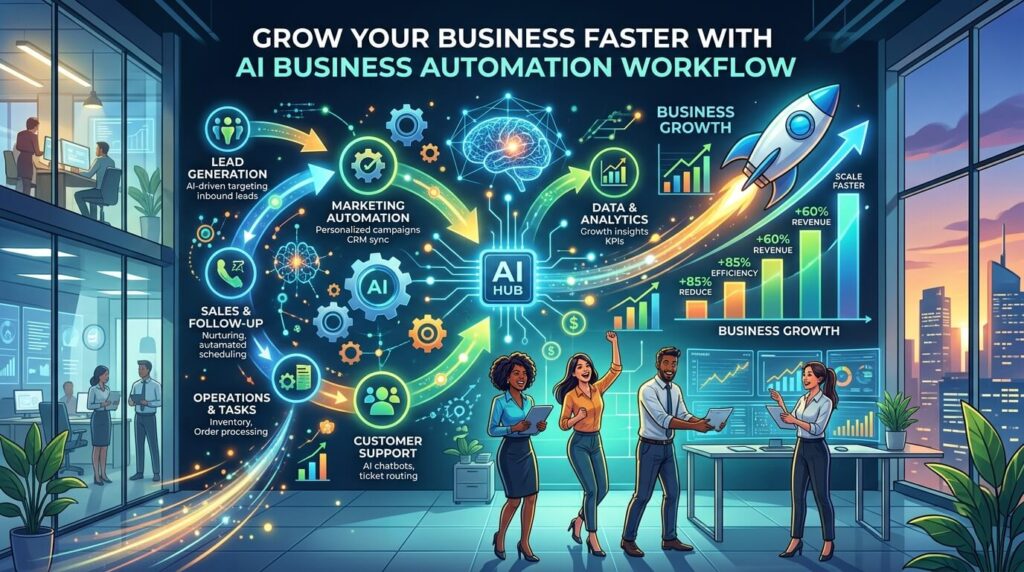
Step 5: Create repeatable workflows
Once you find a useful task, turn it into a process.
For example:
- Collect customer questions
- Use AI to draft replies
- Review and edit the draft
- Send the approved reply
- Save the best answers for later use
This turns one-time AI use into a real business system.
Step 6: Train your team
AI works best when everyone knows how to use it. So, teach your team the basics.
Focus on:
- How to write good prompts
- How to check AI output
- When not to trust the tool
- Which tasks are safe to automate
- How to protect customer data
A team that understands AI will use it more confidently and more effectively.
Smart ways to Grow Your Business Faster with AI
Now let’s look at practical strategies you can use right away.
1. Use AI for faster content creation
Content marketing still matters. But writing blogs, emails, and social posts takes time. AI can help you draft content faster.
Use it for:
- Blog outlines
- Headline ideas
- Email subject lines
- Product descriptions
- Ad variations
- Social captions
Then add your own experience, examples, and brand voice. That is what makes the content useful and trustworthy.
2. Use AI to improve customer support
Fast support builds trust. AI chatbots can answer common questions instantly. They can also guide visitors to the right page or product.
This helps you:
- Reduce support wait times
- Lower support workload
- Improve customer satisfaction
- Stay available after business hours
Still, do not let bots handle everything. Complex or sensitive issues should go to a real person.
3. Use AI to understand your data
Many businesses collect data but do not use it well. AI can help summarize trends from sales reports, website analytics, and customer feedback.
For example, AI can help you find:
- Which products sell best
- Which emails get the most clicks
- Which pages lose visitors
- Which customer complaints appear most often
That information can help you make faster, smarter decisions.
4. Use AI to speed up sales work
Sales teams waste a lot of time on small tasks. AI can help with prospect research, email drafts, and follow-up messages.
It can also help you:
- Rank leads by priority
- Write customized outreach messages
- Summarize sales calls
- Create next-step notes
As a result, your team can spend more time selling and less time typing.
5. Use AI to automate repetitive tasks
Repetition kills productivity. AI automation can handle tasks like:
- Moving data between tools
- Sending reminders
- Organizing leads
- Creating reports
- Tagging support tickets
This saves time every week. Over time, those small savings become major gains.

Productivity improvement strategies that help you Grow Your Business Faster
AI is useful, but it works even better when your workflow is clean. So, combine AI with better productivity habits.
Keep tasks simple and repeatable
AI works best when the process is clear. Break big tasks into small steps. Then use AI where the pattern repeats.
Use templates
Build templates for:
- Emails
- Proposals
- Social posts
- Meeting summaries
- Customer replies
Then let AI fill in the first draft. This keeps your work consistent and fast.
Review before publishing
Never publish AI output without checking it. Look for:
- Wrong facts
- Awkward wording
- Repeated ideas
- Unclear claims
- Brand voice problems
This protects your reputation.
Track time saved
Measure results. For example, note how long a task took before AI and after AI. That shows where the tool is helping most.
Keep humans in charge
AI should support your team, not replace judgment. People should still make the final call on strategy, quality, and customer care.
Real-world examples of how AI helps businesses
Here are a few simple examples.
Example 1: A small online store
A small store uses AI to write product descriptions and email follow-ups. As a result, the owner saves hours every week and launches new products faster.
Example 2: A service business
A local agency uses AI to draft proposal outlines and meeting notes. The team responds faster to leads and closes more projects.
Example 3: A support team
A SaaS company uses AI chat support for common questions. Human agents then focus on complex issues. Customer wait times drop.
Example 4: A content creator
A solo founder uses AI to generate blog ideas, outlines, and first drafts. This helps them publish more often without burning out.
These examples show a clear pattern. AI does not need to do everything. It only needs to remove friction.
Advantages and disadvantages of using AI in business
AI has strong benefits, but it also has limits. A smart business owner should know both.
Advantages
- Saves time on repeat work
- Helps teams work faster
- Improves content production
- Supports better data analysis
- Makes customer service more efficient
- Can reduce operating costs
- Works well for teams of any size
Disadvantages
- Can produce wrong or fake information
- Still needs human review
- May sound generic if overused
- Can create privacy risks if used carelessly
- May require training and setup time
- Some tools cost money
- Poor use of AI can damage trust
So, use AI with discipline. Do not treat it like a perfect expert.
Internal linking suggestions
To strengthen your site structure and SEO, link this article to related pages such as:
- AI Tools for Small Businesses
- How to Improve Business Productivity
- Best Marketing Automation Strategies
- How to Write Better Prompts for AI
- Customer Service Automation Guide
These links help readers move deeper into your site and help search engines understand your content.
Use helpful to make the article more engaging.
- Grow Your Business Faster with AI tools
- Grow Your Business Faster with AI-driven business
- Grow Your Business Faster using AI chat support for customers
- Grow Your Business Faster with an AI business automation workflow
FAQ: Grow Your Business Faster with AI
1. Can small businesses really use AI effectively?
Yes. Small businesses often benefit the most because AI saves time and reduces the need for large teams.
2. Do I need technical skills to use AI tools?
No. Many AI tools are built for non-technical users. You only need to learn the basics and practice good prompts.
3. What is the easiest way to start using AI in business?
Start with one repeated task, such as writing emails or creating content. Then test one tool and measure the results.
4. Can AI replace my team?
No. AI can support your team, but it should not replace human judgment, creativity, or customer care.
5. How do I avoid mistakes when using AI?
Always review AI output before publishing it. Check facts, tone, and accuracy. Never use it blindly.
6. Is AI expensive?
Not always. Some tools are free or low-cost. However, advanced tools and automation platforms may require a paid plan.
7. What business tasks should I not give to AI?
Do not give AI sensitive decisions, private customer data without safeguards, or final approval on important matters without human review.

Conclusion
AI can help you Grow Your Business Faster, but only if you use it with purpose. Start with one problem. Choose one good tool. Build a simple workflow. Then improve it over time.
Do not chase every new AI trend. Focus on tasks that save time, improve quality, or increase sales. That is where the real value is.
If you use AI wisely, you can work faster, serve customers better, and make smarter business decisions. That is how modern businesses grow.
External authoritative references
For further reading, check these trusted sources:
- OpenAI Help Center
- Google Cloud AI documentation
- Microsoft Learn: AI and automation resources
- IBM: AI business guides
These sources are useful for learning more about AI tools, automation, and practical business use.