

Reviewed 20 August 2026.
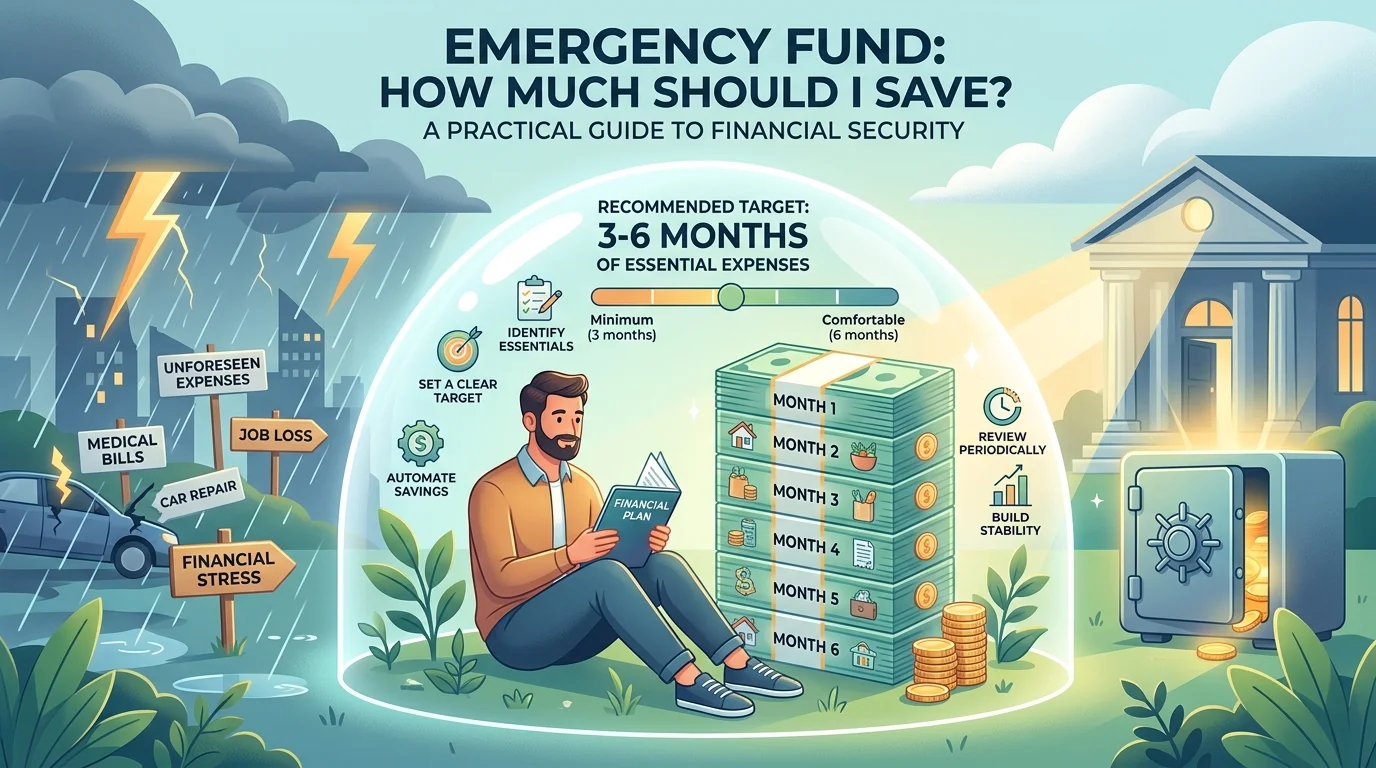
An emergency fund is money reserved for unplanned expenses or a temporary loss of income. A common starting point is three to six months of essential living expenses, but the right target can vary substantially. Your income pattern, dependants, insurance, access to other reliable resources, and likely emergency costs all matter.
This article provides general financial education. Gacalo operates from Somalia, while the CFPB, FINRA, FDIC, and NCUA guidance cited below is specific to the United States. Account names, deposit protection, taxes, benefit rules, and healthcare costs differ by country. If you are outside the United States, check your local financial regulator and deposit-guarantee scheme before choosing an account.
What an emergency fund is for
The Consumer Financial Protection Bureau defines an emergency fund as a cash reserve set aside for unplanned expenses or financial emergencies. Examples include an unexpected medical bill, urgent car or home repairs, and loss of income.
A practical test is to ask whether the cost is necessary, unplanned, and time-sensitive. If all three apply, using the fund may be reasonable. Routine bills, planned travel, gifts, and predictable annual costs belong in a normal budget or a separate savings category.
- Suitable uses: an essential repair, an uninsured urgent cost, emergency travel, or basic expenses during an income interruption.
- Usually unsuitable uses: planned shopping, entertainment, routine maintenance, or an expense that was known in advance.
How much should you save?
FINRA says financial planners often recommend three to six months of living expenses. It also notes that people with variable income or specialised careers might need a larger reserve than people with stable jobs. Treat this range as a starting point, not a requirement.
Step 1: total one month of essential expenses
Use amounts you actually pay rather than a percentage of income. Review recent statements and include only costs that must continue during an emergency:
- housing, including rent or mortgage payments;
- basic utilities and communications;
- groceries and essential household supplies;
- transport needed for work, care, or essential errands;
- insurance premiums and necessary healthcare costs;
- minimum debt payments;
- essential costs for children or other dependants.
Exclude discretionary spending that you could pause, such as entertainment and non-essential subscriptions. If a medical premium or other recurring cost is already in the monthly total, do not add the same cost again as a separate emergency exposure.
Step 2: choose a coverage period
Use the following factors to decide whether the lower or higher end of the range better reflects your circumstances. These are editorial comparison criteria, not regulator-set categories or personalised advice.
| Factor | Reason a shorter reserve may be workable | Reason to consider a longer reserve |
|---|---|---|
| Income pattern | Two stable and independent household incomes | One income, irregular pay, seasonal work, or concentrated income sources |
| Job replacement | Skills are widely transferable and interruptions are likely to be brief | Work is specialised or finding comparable work may take longer |
| Dependants | Few essential costs depend on your income | Children, relatives, or other people rely on your income |
| Insurance and likely costs | Relevant risks are insured and required payments are manageable | Deductibles, exclusions, or essential uninsured costs are substantial |
| Other reliable resources | You have accessible resources that do not depend on borrowing or selling volatile assets | Alternatives are limited, expensive, restricted, or exposed to market loss |
A small starter reserve can still be useful if several months of expenses currently feels unreachable. Base the starter amount on a likely unplanned cost, then build toward a monthly-expense target. Do not skip rent, food, insurance, minimum debt payments, or another urgent obligation merely to reach the target sooner.
Step 3: calculate the target
Use this worksheet:
Emergency-fund target = monthly essential expenses × selected coverage months + specifically identified emergency exposure
The final term is optional. Use it only for a distinct, plausible cost that is not already included in monthly expenses and is not adequately covered by insurance or another reliable resource. This reduces the risk of double-counting.
The following dollar example is hypothetical. Dollars are used only to make the arithmetic easy to follow.
| Essential expense | Assumed monthly amount |
|---|---|
| Rent | $800 |
| Electricity | $150 |
| Groceries | $300 |
| Transport | $150 |
| Insurance | $100 |
| Minimum debt payments | $200 |
| Total | $1,700 |
- Three months: $1,700 × 3 = $5,100
- Six months: $1,700 × 6 = $10,200
- Twelve months: $1,700 × 12 = $20,400
The twelve-month result shows how the formula works for a longer period. It is not a default recommendation. If this household selected six months and separately identified a $600 uninsured essential repair exposure, the worksheet result would be $10,200 + $600 = $10,800.
Where to keep emergency savings
Prioritise safety, access, fees, withdrawal conditions, and protection against provider failure. FINRA recommends a liquid, interest-bearing account that allows access without a withdrawal penalty. It also advises checking the access rules, fees, and penalties before using alternatives such as certificates of deposit or money market funds.
Do not assume that every product labelled “cash,” “money market,” or “cash management” has the same protection. A money market deposit account is a bank deposit product; a money market mutual fund is an investment product. A cash management account may move money among partner banks, so its protection can depend on the provider, participating institutions, account records, and sweep arrangement.
United States only: FDIC deposit insurance covers eligible deposits at FDIC-insured banks, including savings accounts and money market deposit accounts. The standard amount is $250,000 per depositor, per insured bank, per ownership category. Mutual funds, stocks, and bonds are not FDIC-insured. At federally insured credit unions, the NCUA explains federal share-insurance coverage and account categories, generally including up to $250,000 for common ownership types subject to applicable rules. Confirm that the institution is insured and that the product and ownership arrangement qualify.
Volatile investments are generally a poor match for money that may be needed at short notice. FINRA notes that an emergency buffer can reduce the risk of having to sell investments at a loss during a market downturn.
How to build the fund
Set a starter amount and a monthly contribution
Separate the full target from the first milestone. For example, someone with a $5,100 target might first save an amount tied to a likely urgent cost, then continue toward one month of essential expenses and later toward the selected coverage period.
Choose a contribution that fits actual cash flow. Automatic transfers can make saving consistent, but the CFPB advises monitoring the source-account balance to avoid overdraft fees when a transfer occurs.
Use one-time income deliberately
A tax refund, bonus, cash gift, or other one-time receipt can shorten the amount still to save when using it does not conflict with urgent obligations. The FDIC identifies automated deposits and windfalls such as tax refunds or work bonuses as ways to build emergency savings.
Track progress without predicting it
A simple planning calculation is:
Amount still needed ÷ affordable monthly contribution = number of contributions required
Assume the target is $5,100, the current balance is $1,500, and the affordable contribution is $300 per month. The amount still needed is $3,600, and $3,600 ÷ $300 = 12 monthly contributions. This is an arithmetic schedule, not a forecast. Fees, withdrawals, income changes, and interest can change the actual date.
How to balance emergency savings with other priorities
Building the largest possible cash balance is not always the next priority. Continue essential spending and required minimum debt payments. Then consider the risk of having no reserve, the interest and fees on debt, and the likelihood of a near-term emergency. FINRA specifically notes that people with high-interest debt must decide how to balance debt reduction with establishing or adding to an emergency fund.
Holding more cash than your plan requires also has a trade-off. Cash may earn less than long-term investments and can lose purchasing power when its return is below inflation. A larger reserve can nevertheless be rational when income is unstable or risks are concentrated. Review the target rather than assuming that either the smallest or largest balance is always correct.
Emergency-fund maintenance checklist
- Write down what qualifies as an emergency before one occurs.
- Keep the money separate from routine spending if that helps prevent accidental use.
- Check access times, fees, withdrawal restrictions, and applicable deposit protection.
- Review the target after a job change, move, change in dependants, insurance change, or major shift in essential expenses.
- Replenish the fund after using it, at a pace that does not displace urgent obligations.
- Recheck automatic transfers when income or bill dates change.
Common questions
Is $1,000 enough for an emergency fund?
It may be a useful starter amount for some households, but it is not a universal benchmark. Compare it with your likely urgent costs and one month of essential expenses, then set the next milestone.
Should I pay debt before saving?
There is no single order that fits everyone. Keep required payments current, then weigh debt cost against the consequences of facing an emergency with no cash reserve. FINRA’s guidance above expressly recognises this balance for high-interest debt.
Should I invest my emergency fund?
Money needed for emergencies should prioritise liquidity and stability. FINRA recommends an easily accessible, interest-bearing account and warns readers to check fees, penalties, and access before choosing alternatives. Long-term investments can fall in value when the cash is needed.
Conclusion
Start by totaling one month of essential expenses, choose a coverage period based on household risks and reliable resources, and add only distinct emergency exposures that are not already counted. Keep the reserve accessible and verify the provider, product terms, and applicable protection. A three-to-six-month range is a useful reference point, not a personal rule. Begin with a workable milestone, review it when circumstances change, and rebuild the fund after using it.
This article was prepared by the Gacalo editorial team through review of the official sources linked in the text. It is general education, not individual financial, investment, tax, or legal advice.


