
The best passive income ideas for students in 2026. Real strategies that earn money while you sleep, study, and build your future without quitting school.
passive income ideas for Students with no money for students
Nobody warned me that being a full-time student and being completely broke could exist simultaneously for years at a stretch. Tuition. Rent. Groceries. Textbooks that cost more than a plane ticket. And somewhere in the middle of all of that the advice adults offer is almost always some version of get a part-time job as if trading your only free hours for minimum wage is the obvious and only answer.
It is not the only answer. And for a growing number of students in 2026, it is not even the best one.
Passive income ideas for students have moved from the realm of financial fantasy into genuinely practical territory over the last few years. The tools available now — AI writing assistants, design platforms, print on demand services, affiliate networks, digital product marketplaces — have dramatically lowered the barrier between a student with a laptop and a student with actual recurring income that does not require trading every available hour for a paycheck.
This article covers the passive income strategies that work specifically for students. Not theoretical possibilities. Not things that require startup capital you do not have. Real income methods organized by ease of entry, realistic earning potential, and honest time-to-first-income assessments. Every strategy here can be started with a standard laptop, a reliable internet connection, and a willingness to invest a few focused weeks before the income begins arriving.
What Passive Income Actually Means for a Student and Why It Matters
Before diving into specific methods, it is worth being precise about what passive income means in a student context because the term gets used loosely in ways that create unrealistic expectations.
True passive income means income that continues arriving after the initial work of creating it is complete. A digital product you upload once and sell repeatedly. A YouTube video that earns advertising revenue months after you published it. An affiliate link in a blog post that generates commission from readers who find it through search long after you wrote the post.
Semi-passive income means income that requires ongoing but minimal maintenance — a print on demand store that needs occasional new designs, a newsletter that generates sponsorship income with a few hours of weekly writing, or a social media following that drives affiliate sales with regular but time-efficient posting.
Both categories are genuinely valuable for students because both allow income to accumulate during the hours you are in class, studying, sleeping, and living your life. The distinction matters because setting accurate expectations about how much ongoing attention each method requires prevents the abandonment that occurs when students discover that passive does not mean completely automatic.
The deeper reason passive income matters for students specifically is not just the money. It is the compounding effect of building income systems during a period of your life when you have both the time flexibility and the digital nativity to set them up faster and more effectively than most adults who discover these methods later.
Passive Income Ideas for Students That Work in 2026
Selling Digital Products on Etsy and Gumroad
Digital products are the entry point with the lowest barrier and one of the strongest long-term earning potentials available to student creators. The core advantage is the economics — you create a product once and it sells repeatedly with zero additional production cost per unit.
For students, the most natural digital product categories are the ones that emerge from your own academic experience. Study guides organized the way students actually study rather than the way publishers assume they do. Subject-specific notes in formats that work for visual learners. Revision planners, homework trackers, and academic calendar templates. Essay outline frameworks for common assignment types. Flashcard sets for specific courses. Language learning resources.
Every one of these product types benefits from a creator who has recently lived the problem the product solves — which is a genuine competitive advantage that student creators have over adult sellers who are guessing about what students need.
Etsy is the primary marketplace for physical-format digital downloads — printable planners, wall art, sticker sheets, and template packs. Gumroad is stronger for knowledge-based products — study guides, ebooks, course supplements, and resource packs. Both platforms process payment and deliver the digital file automatically, making every sale genuinely passive after the initial upload.
A student who publishes 20 to 40 well-optimized digital products on Etsy can realistically earn $200 to $800 per month within six months of consistent shop building. The monthly income continues growing as the catalog expands and the shop gains algorithmic traction on the platform.
Starting a Niche Blog with Affiliate Income
A niche blog that earns through affiliate marketing is one of the most time-tested passive income methods available and in 2026 it remains one of the most scalable options for students willing to invest in content creation over a medium-term timeline.
The niche selection decision is the most important one you will make. A broad general blog about making money online competes with millions of established websites. A blog about productivity tools specifically for nursing students, or personal finance strategies for international students studying abroad, or budget travel guides for college students in a specific region competes with almost nobody while serving an audience with very specific needs and strong search intent.
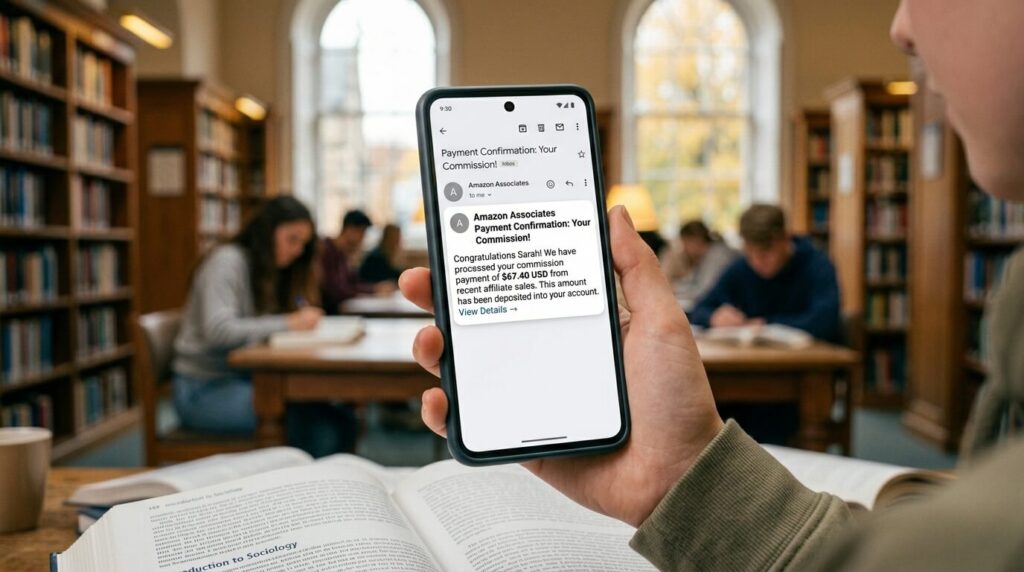
Affiliate income on a blog works by recommending products and services that are directly relevant to your content and receiving a commission when readers make purchases through your affiliate links. Amazon Associates, ShareASale, and Impact are the most accessible affiliate networks for beginner bloggers. Commission rates vary from 1 to 2 percent on Amazon products to 20 to 50 percent on digital product commissions through other networks.
The honest timeline for meaningful affiliate blog income is four to twelve months of consistent publishing before organic search traffic reaches levels that generate reliable monthly commissions. Students who start a niche blog in their first year of university and maintain it consistently often graduate with a genuine supplemental income stream that continues growing after graduation.
AI tools have made this timeline significantly more achievable for students. Using ChatGPT or Claude for research synthesis and first-draft production, combined with genuine personal experience and subject knowledge for editing and refinement, allows a student blogger to publish high-quality content two to three times faster than writing from scratch.

Print on Demand Stores for Student Designers
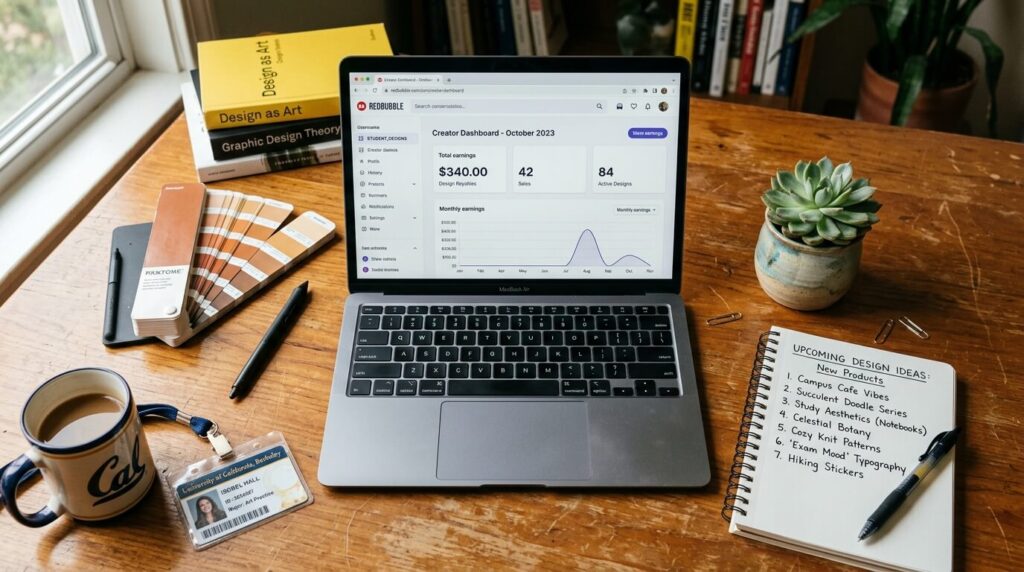
Print on demand allows students with design skills — or students willing to develop basic design skills using free tools like Canva — to sell custom-designed physical products without managing inventory, production, or shipping. Every product is manufactured and delivered by the platform only after a customer places an order.
Redbubble, Merch by Amazon, and Society6 are the primary platforms. A student uploads an original design and the platform makes it available on dozens of product types — t-shirts, hoodies, phone cases, notebooks, stickers, tote bags, and mugs. Every sale generates a royalty with no ongoing work required after the upload.
The design categories that sell most consistently are niche humor and community-specific inside jokes, aesthetic minimalist designs that work across multiple product types, subject-specific academic designs for specific university departments and majors, and seasonal and holiday designs uploaded well in advance of the relevant dates.
A student who uploads two to three new designs per week consistently over a semester can build a catalog of 30 to 50 designs that generates $100 to $400 per month in passive royalties by the end of the semester.
YouTube Channel Monetization
YouTube represents one of the highest passive income ceilings available to student creators and one of the longer timelines to meaningful income. Understanding both sides of that reality is essential before starting.
The YouTube Partner Program requires 1,000 subscribers and 4,000 watch hours before advertising revenue begins. For most new channels publishing consistently, that milestone takes six to eighteen months. The income once monetization activates depends almost entirely on niche — channels in personal finance, technology, and academic content earn significantly more per thousand views than channels in entertainment categories.
The content strategies with the strongest growth rates for student creators in 2026 are study-with-me videos and academic content that serves the hundreds of thousands of students searching for study motivation and subject-specific explanations, personal finance and budgeting content for students navigating money management for the first time, and niche tutorials that address specific problems in specific academic fields with genuine subject expertise.
AI tools have made YouTube content production accessible to student creators who do not want to appear on camera. ChatGPT for script writing, ElevenLabs for natural-sounding voiceover narration, and Canva AI for thumbnail creation allow a student to produce a complete educational YouTube video without filming themselves — a workflow that removes one of the most common barriers to starting.
Stock Photography and Video Licensing
Students who already take quality photos with their smartphones or cameras can submit that content to stock photography platforms and earn passive licensing income every time a buyer downloads their images or video clips.
Adobe Stock, Shutterstock, and Pond5 all accept contributor submissions and pay royalties on every download. The content categories with the strongest consistent demand on stock platforms are authentic lifestyle photography featuring students, study environments, and campus scenes, food and beverage photography, and nature and landscape footage.
The passive income from stock photography is modest compared to other methods — most contributors earn $0.25 to $4 per download depending on the platform and license type. The income becomes meaningful through volume — a contributor with 500 to 1,000 high-quality images in active library can earn $100 to $600 per month in passive licensing income.
The advantage for student photographers is that their daily environment — campus, student housing, libraries, cafes, study groups — contains exactly the kind of authentic lifestyle imagery that stock buyers actively seek and established photographers rarely produce because they no longer inhabit those spaces naturally.
Publishing Ebooks on Amazon Kindle Direct Publishing
Amazon Kindle Direct Publishing allows anyone to publish and sell ebooks directly through Amazon’s platform with no upfront cost and royalties of 35 to 70 percent of the sale price depending on the price point and distribution selections.
For students, the most commercially viable ebook categories are non-fiction guides that emerge naturally from their academic expertise or personal experience. Study technique guides for specific subjects or learning styles. Personal finance guides written specifically for students. Guides to navigating specific aspects of university life — scholarship applications, internship acquisition, graduate school applications. Guides to the specific skills, tools, or knowledge the student has developed through coursework or self-study.
A well-written, properly formatted ebook priced at $4.99 to $9.99 generating 30 to 100 sales per month produces $75 to $500 in monthly passive royalties with no ongoing work required after the initial writing and formatting.
Creating and Selling Online Courses
Online courses represent the highest per-unit income of any passive income method available to students and the one that requires the most significant upfront time investment to create well.
Platforms including Teachable, Gumroad, and Udemy provide the infrastructure for course hosting, payment processing, and student management. The course creator’s investment is the curriculum design and content production — recorded lessons, accompanying materials, and exercises — which for a focused course of three to five hours of content typically requires three to eight weeks of consistent production work.
The course topics where student creators have the strongest natural authority are the skills and knowledge areas they have most recently mastered. A computer science student who taught themselves machine learning. A pre-medical student who developed an effective MCAT preparation system. A language student who became conversationally fluent in a third language within a year. A first-generation university student who successfully navigated the scholarship application process.
The subject knowledge does not need to be rare or advanced. It needs to be organized, explained clearly, and genuinely helpful to people one step behind where the creator currently stands. That positioning is where student course creators have an authentic credibility advantage over established professionals who have forgotten what the learning process actually felt like from the inside.
Using AI Tools to Accelerate Every Passive Income Strategy
This deserves its own section because it changes the time investment calculation for every method on this list significantly.
ChatGPT and Claude reduce the research and writing time for blog posts, ebook drafts, course scripts, and product descriptions by 60 to 80 percent for most users. The student’s role shifts from starting from nothing to directing, editing, and refining AI-generated first drafts with genuine subject knowledge and personal voice.
Canva AI generates professional design work for Etsy products, YouTube thumbnails, course materials, and blog graphics without requiring formal design training or expensive software subscriptions.
ElevenLabs converts written scripts into natural-sounding audio for YouTube videos, course lessons, and podcast-style content without recording equipment or a controlled acoustic environment.
These tools do not replace the judgment, expertise, and personal experience that make passive income content genuinely valuable. They remove the production friction that prevents students from creating that content at the volume and consistency required to build meaningful income streams within a student timeline.
How to Choose the Right Passive Income Method as a Student
The right starting point depends on three specific variables that differ for every student.
Time availability is the first variable. A student with five to seven hours per week available for income building has different optimal starting points than a student with fifteen to twenty. Digital products and print on demand require less ongoing time once the initial catalog is established. A blog and YouTube channel require more consistent weekly investment, particularly in the early months.
Existing skills are the second variable. A student who already writes well reaches blog monetization faster. A student with design experience builds a more profitable print on demand store more quickly. A student with specific academic expertise creates more credible and better-selling course content. Starting with a method that builds on existing strengths rather than requiring simultaneous skill development and income generation produces better early results and reduces the abandonment that discourages many beginner passive income builders.
Timeline to income need is the third variable. Digital product sales on Etsy can generate first income within two to four weeks of the first well-optimized listing going live. Blog affiliate income typically requires four to twelve months before reaching meaningful levels. YouTube advertising revenue requires reaching partner program eligibility which takes most new channels six to eighteen months. Choose methods with timelines that match your actual income need rather than purely your income ambition.
FAQ Section
What is the easiest passive income idea for a student with no money to invest?
Digital products on Etsy or Gumroad require zero financial investment to start. Creating study guides, templates, or printables using free tools like Canva and uploading them to these platforms costs nothing and generates income from every sale. This is consistently the most accessible zero-investment starting point for student passive income.
How long does it take for a student to start earning passive income?
Timeline varies significantly by method. Digital product stores can generate first sales within two to four weeks. Print on demand stores typically see first sales within one to six weeks depending on niche and design quality. Blog affiliate income takes four to twelve months to become meaningful. YouTube monetization takes six to eighteen months of consistent publishing for most new channels.
Can a student really earn enough passive income to cover living expenses?
With time and consistency, yes. Students who build multiple passive income streams simultaneously — a digital product store, an affiliate blog, and a print on demand shop running concurrently — have reported replacing significant portions of their living expenses within one to two years. The first six months typically generate supplemental income rather than replacement income. The compounding growth over the following twelve to eighteen months is where the income levels that meaningfully change a student’s financial situation become achievable.
Do students need to pay taxes on passive income earned online?
In most countries yes, once income crosses reporting thresholds. In the United States, self-employment income over $400 in a tax year is reportable regardless of age or student status. The IRS at irs.gov provides specific guidance on reporting requirements for online income. Students earning through multiple platforms should track all income from the beginning of their first earning year and consult a parent, advisor, or tax professional before their first filing deadline.
Is it possible to build passive income as a student using AI tools?
Yes, and AI tools have made passive income building meaningfully more accessible for students specifically. ChatGPT and Claude reduce content production time for blogs, ebooks, and course materials dramatically. Canva AI generates professional design assets for digital products and marketing materials without design training. ElevenLabs produces voiceover narration for YouTube content without recording equipment. Used thoughtfully as production accelerators rather than complete content generators, these tools allow students to build passive income assets at a speed that would have been impossible three years ago.
What is the most profitable passive income method for students in 2026?
The most profitable single method for most students over a two-year horizon is online course creation combined with a supporting blog or YouTube channel that drives traffic to the course. A well-produced course on a subject the student has genuine expertise in, priced between $47 and $197, with even 10 to 30 sales per month generates $470 to $5,910 monthly in passive royalties. The combination of a course with a content channel that drives organic discovery compounds the income potential significantly beyond what either would generate independently.

Conclusion
Building passive income as a student is not about getting rich quickly or replacing the value of your education with a side hustle. It is about using the unique combination of time flexibility, digital fluency, and fresh subject expertise that the student years offer to build income systems that work while you study, sleep, and live your life.
The students who will graduate in the next two to four years with meaningful passive income streams already generating monthly revenue are the ones who start building in their first or second year rather than waiting until they have more time, more skills, or more certainty. Those things arrive through the doing, not before it.
Every method on this list can be started this week with the tools you already have. The only decision left is which one to begin with today.
If you found this article genuinely useful, share it with a student in your life who is still trading time for minimum wage when a better option is sitting one decision away. And if you have already started building passive income as a student, share which method is working best for you in the comments — real experience from real students is the most valuable information in this entire space.