

Explore the Types of Digital Marketing, from SEO to influencer campaigns, and learn how each strategy helps brands grow online effectively.
Introduction
Digital marketing has become one of the most important ways for businesses to reach people in a fast, measurable, and cost-efficient way. Today, customers spend time on search engines, social platforms, websites, apps, and email inboxes. That means brands must show up in the right places with the right message.
The challenge is that digital marketing is not one single method. It is a broad field made up of different channels, tactics, and goals. Some methods are designed to increase visibility. Others are better for generating leads, building trust, or driving sales. That is why understanding the Types of Digital Marketing matters so much.
When businesses know how each type works, they can choose the right mix for their audience, budget, and goals. A startup may rely heavily on content and social media. An online store may focus on SEO, PPC, and email. A service business may benefit from local search and paid campaigns. The best results usually come from combining several methods rather than depending on only one.
In this guide, you will learn what digital marketing is, explore the main Types of Digital Marketing, understand the benefits, and discover how to choose the right approach for your business.
Explanation of Digital Marketing
Digital marketing is the practice of promoting products, services, or brands using digital channels. These channels include search engines, websites, email, social media platforms, mobile apps, and online ads. Unlike traditional marketing, digital marketing allows brands to track performance, measure results, and adjust campaigns in real time.
One of the biggest strengths of digital marketing is flexibility. A campaign can be launched quickly, tested on a small scale, improved based on data, and expanded if it performs well. This makes it useful for businesses of all sizes.
Digital marketing also helps brands connect with people more personally. Instead of sending one message to everyone, businesses can target specific audiences based on interests, behavior, location, age, search intent, or past interactions. As a result, marketing becomes more relevant and more effective.
At its core, digital marketing includes two major ideas:
- Reaching people where they already spend time online
- Using data to improve decision-making and performance
Because of this, digital marketing has become essential for growth in almost every industry.

Types of Digital Marketing
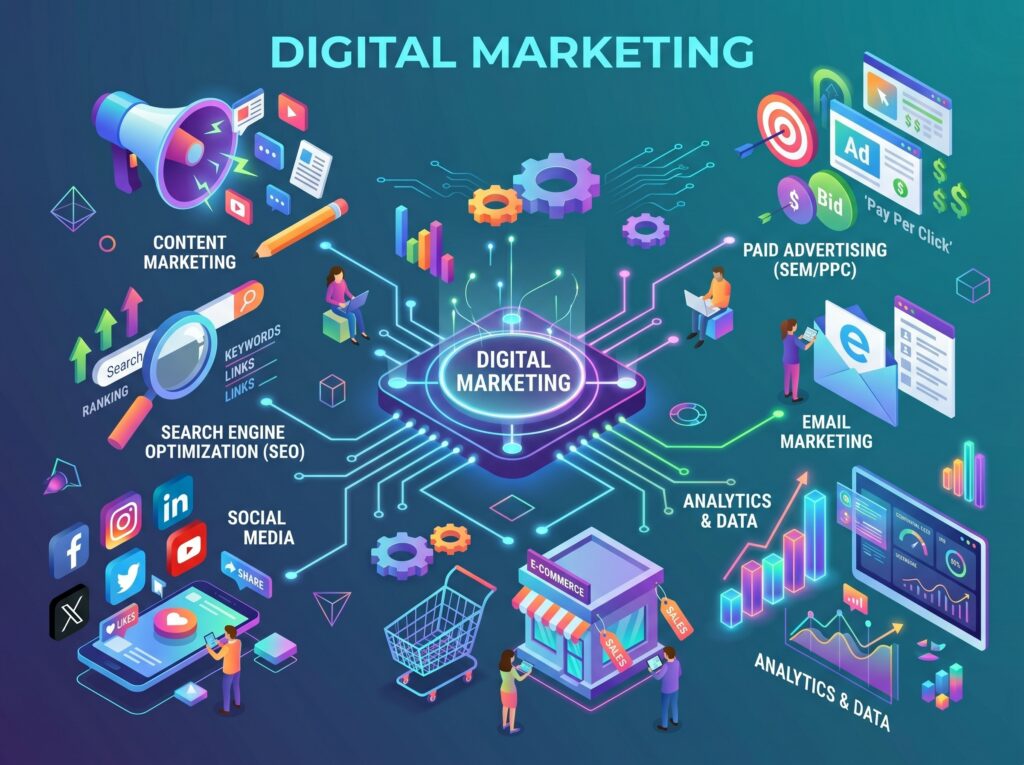
There are many ways to market a business online, but the most common and useful strategies fall into a few main categories. Below are the most important Types of Digital Marketing and how each one works.
Search Engine Optimization (SEO)
Search Engine Optimization, or SEO, is the process of improving a website so it ranks higher in search engine results. The goal is to attract organic traffic, which means visitors who find a site naturally rather than through paid ads.
SEO matters because people often search online before making a decision. Whether they want to buy a product, compare services, or learn something new, search engines are usually the first stop.
SEO typically includes:
- Keyword research
- On-page optimization
- Technical SEO
- Link building
- High-quality content creation
- Local SEO
A strong SEO strategy helps a website become more visible, more trustworthy, and more useful to users. It is not a quick fix, but it can deliver long-term results. Over time, good SEO can bring steady traffic without paying for every click.
/digital-marketing-for-small-businesses-2026/
Content Marketing
Content marketing focuses on creating and sharing valuable information to attract and retain an audience. Instead of directly selling, it educates, informs, entertains, or solves problems.
This type of marketing includes:
- Blog articles
- Guides and tutorials
- Videos
- Infographics
- Podcasts
- Ebooks
- Case studies
- White papers
Content marketing works because people trust useful content. When a brand answers questions clearly and consistently, it builds authority and credibility. It also supports SEO, social media, and email marketing by giving businesses something valuable to share.
For example, a software company may publish how-to guides that help users solve common problems. A fashion brand may create style inspiration posts or video tutorials. A financial services company may explain budgeting tips or investment basics. In every case, the content creates value before asking for a sale.

Social Media Marketing
Social media marketing uses platforms like Facebook, Instagram, LinkedIn, TikTok, X, Pinterest, and others to reach audiences, build communities, and promote products or services.
This type of marketing can be organic, paid, or both. Organic social media focuses on regular posts, stories, videos, and community interaction. Paid social media uses advertising tools to reach specific groups of people.
Social media marketing is useful for:
- Brand awareness
- Community building
- Customer engagement
- Product promotion
- Traffic generation
- Lead generation
It is especially powerful because it allows two-way communication. Businesses can speak to customers, but customers can also respond, share, comment, and ask questions. That interaction helps brands feel more human and more accessible.
However, social media requires consistency. A few random posts will not create strong results. Brands need a clear voice, useful content, and a posting strategy that fits the platform and audience.
Email Marketing
Email marketing is the use of email to communicate directly with leads, customers, and subscribers. It remains one of the most reliable and cost-effective digital marketing methods.
Email is valuable because it reaches people in a personal space: their inbox. Unlike many other channels, email gives brands direct access to an audience that has already shown interest.
Common email marketing campaigns include:
- Welcome emails
- Newsletters
- Promotional offers
- Product updates
- Abandoned cart reminders
- Re-engagement campaigns
- Lead nurturing sequences
Email marketing works best when messages are targeted and relevant. Generic emails often get ignored, while personalized emails can improve open rates, clicks, and conversions.
It is also one of the best tools for long-term customer relationships. A brand can use email to keep buyers informed, encourage repeat purchases, and build loyalty over time.

Pay-Per-Click Advertising (PPC)
Pay-Per-Click advertising, or PPC, is a paid marketing method where advertisers pay each time someone clicks on their ad. These ads often appear on search engines, social media platforms, and other websites.
Google Ads is one of the most common PPC systems, but PPC also includes ads on LinkedIn, Facebook, Instagram, YouTube, and display networks.
PPC is often used when businesses want fast visibility. Unlike SEO, which can take time, PPC can place a brand at the top of search results almost immediately.
PPC is useful for:
- Quick traffic
- Product launches
- Seasonal promotions
- Lead generation
- Competitive keyword targeting
- Remarketing campaigns
The main advantage of PPC is control. Businesses can choose audience, budget, timing, and message. However, it requires careful management. Poor targeting or weak ad copy can waste money fast. Good PPC campaigns depend on strong landing pages, accurate tracking, and ongoing optimization.
Affiliate Marketing
Affiliate marketing is a performance-based strategy where businesses pay partners, known as affiliates, a commission for driving sales or leads. Affiliates promote products or services through websites, blogs, social media, newsletters, or videos.
This model works because it spreads marketing efforts across many promoters without paying for exposure upfront. Instead, businesses pay only when a desired action happens.
Affiliate marketing can involve:
- Product reviews
- Comparison articles
- Tutorial content
- Referral links
- Coupon partnerships
- Influencer collaborations
For businesses, affiliate marketing can be a scalable way to increase sales. For affiliates, it offers a way to earn income by recommending useful products.
That said, success depends on trust. Affiliates must promote products honestly, and businesses must choose partners carefully. If the promotion feels misleading, audiences will lose confidence quickly.

Influencer Marketing
Influencer marketing involves collaborating with individuals who have built trust and visibility within a specific audience. These influencers may have large followings or smaller, highly engaged communities.
Brands work with influencers to promote products, share experiences, or create authentic content. This type of marketing is common on Instagram, TikTok, YouTube, and other content-driven platforms.
Influencer marketing is effective because people often trust recommendations from creators they follow. The message can feel more personal and less corporate than traditional advertising.
It is often used for:
- Brand awareness
- Product launches
- User-generated content
- Social proof
- Audience targeting
The key to influencer marketing is fit. A brand should choose creators whose audience, style, and values match the product. A huge follower count does not always mean better results. In many cases, micro-influencers deliver stronger engagement and more targeted reach.
Mobile Marketing
Mobile marketing focuses on reaching users through smartphones and tablets. Since mobile devices are now central to daily life, this type of digital marketing has become extremely important.
Mobile marketing can include:
- SMS campaigns
- App notifications
- Mobile-friendly websites
- In-app advertising
- Location-based marketing
- Mobile search ads
- QR code campaigns
This channel works because people carry their phones almost everywhere. It allows brands to connect with users in real time and often in context, such as when they are near a store or using an app.
However, mobile marketing needs to be handled carefully. Messages should be short, useful, and timely. Too many notifications or poorly designed mobile pages can frustrate users and reduce engagement.
Benefits of Digital Marketing
Digital marketing offers major advantages over many traditional marketing methods. It is not just about being online; it is about being strategic, measurable, and adaptable.
Here are some of the main benefits:
- Broader reach: Brands can connect with local, national, and global audiences.
- Better targeting: Campaigns can focus on specific groups based on interests, behavior, and demographics.
- Measurable results: Analytics tools make it easier to track traffic, clicks, conversions, and return on investment.
- Cost efficiency: Many digital methods are more affordable than print, TV, or radio advertising.
- Real-time adjustments: Campaigns can be improved quickly based on performance data.
- Stronger engagement: Digital channels allow direct interaction with audiences.
- Higher personalization: Messages can be tailored to customer needs and preferences.
- Scalability: A small campaign can grow into a larger one when it performs well.
In addition, digital marketing helps businesses stay competitive. Customers now expect brands to be available online, easy to find, and responsive. Companies that ignore digital channels often fall behind.
How to Choose the Right Type
Choosing the right mix of digital marketing methods depends on your goals, audience, budget, and industry. No single strategy is perfect for every business. The smartest approach is to match the method to the objective.
Here are some practical factors to consider:

1. Define your goal
Start with the result you want.
- If you want more website traffic, SEO and PPC may be the best choices.
- If you want to build trust and authority, content marketing is strong.
- If you want to stay in touch with customers, email marketing works well.
- If you want to build a community, social media may be better.
- If you want fast sales, PPC and influencer campaigns can help.
2. Understand your audience
Different audiences use different platforms. Younger users may spend more time on short-form video apps. Professionals may prefer LinkedIn. B2B buyers may respond well to email and content, while e-commerce audiences may engage more through social media and mobile campaigns.
3. Consider your budget
Some strategies require more money than others.
- SEO and content marketing often need time and consistent effort.
- PPC requires ongoing ad spend.
- Influencer marketing can be expensive depending on the creator.
- Email marketing is usually cost-effective once the list is built.
A balanced budget often includes both organic and paid strategies.

4. Look at your timeline
Some channels deliver faster results than others.
- PPC can generate traffic quickly.
- Social media may build visibility over time.
- SEO usually takes longer but can offer lasting value.
- Content marketing and email marketing work best as part of a long-term plan.
5. Match the channel to your business model
A local restaurant may benefit from local SEO, social media, and mobile marketing. A SaaS company may focus on SEO, content, and email. An online fashion brand may combine influencer marketing, social media ads, and email promotions.
The best strategy is often a combination. For example:
- SEO brings people to the website
- Content educates them
- Email nurtures them
- PPC accelerates conversions
- Social media keeps the brand visible
When these channels work together, results usually improve.

Conclusion
The modern digital landscape offers many ways to connect with customers, but success depends on choosing the right mix. The main Types of Digital Marketing each serve a different purpose. SEO builds visibility. Content marketing creates trust. Social media marketing drives engagement. Email marketing supports relationships. PPC delivers speed. Affiliate and influencer marketing expand reach. Mobile marketing keeps brands close to users throughout the day.
There is no single best method for every business. Instead, the strongest strategy is the one that fits your goals, audience, and budget while working across multiple channels. When used wisely, digital marketing can help businesses grow visibility, increase conversions, and build long-term customer relationships.
In a competitive online world, the brands that win are the ones that stay relevant, useful, and consistent. Start with one or two channels, measure what happens, and build from there. Over time, a smart digital marketing mix can become one of your most powerful growth assets.